


Communities in Odesa region are experiencing a growing need for systematic work with veterans and their families. The full-scale war has significantly increased the number of people returning to civilian life after combat experience. At the same time, the pressure on local social support systems and on specialists who work directly with this group is increasing.
It is within this context that the Aid4Heroes project was implemented. Its goal was to support the social adaptation of veterans, reduce isolation, and strengthen the capacity of communities to effectively respond to their needs. The project combined several components: psychosocial support, social camps, the work of a mobile multidisciplinary team, training programs for specialists, the development of adaptive sports, and socio-cultural activities.
An important part of this work was the study of the needs of specialists who support veterans at the community level.
At the beginning of the project, a pre-monitoring survey among 97 specialists showed that they regularly deal with complex cases involving social benefits, medical care, rehabilitation, psychological support, and legal issues simultaneously. Also, many respondents noted that existing state programs only partially meet real needs, while bureaucratic procedures, weak inter-agency coordination, and a lack of practical tools complicate their work.
To assess changes and identify current challenges, the Aid4Heroes team conducted an additional survey among 34 veteran support specialists. Its results provide a clearer understanding of the issues these professionals face in their daily work.
1. Expectations vs. Reality: A Role Still Taking Shape
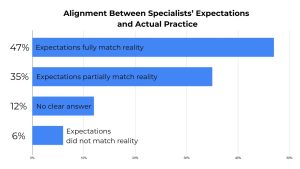
Nearly half of respondents (47%) reported that their expectations of the job fully matched reality. Another 35% noted a partial match, while 6% indicated a clear mismatch.
These findings suggest that the role of a veteran support specialist is still evolving. Some professionals enter the field without a clear understanding of the scope of their future responsibilities, while the system itself has yet to establish consistent boundaries and standards.
2. Training Exists, but Not for Everyone
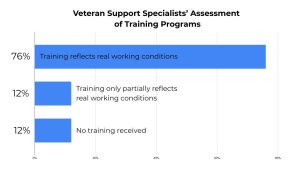
Most respondents positively assess the available training programs. 76% believe they reflect real working conditions, while 12% say they do so only partially.
At the same time, 12% of respondents reported that they had not received any training at all. This indicates that some specialists are required to work without basic preparation, relying solely on personal experience or peer support.
3. Resources and the Risk of Burnout
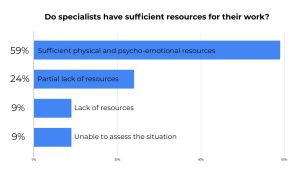
59% of specialists report having sufficient physical and psycho-emotional resources for their work. However, about one-third of respondents experience a full or partial lack of such resources.
This is an important signal, as working with veterans often involves engagement with traumatic experiences, crisis situations, and complex life circumstances. Without additional support, this may lead to professional burnout.
4. An Overlooked Challenge: Veterans Do Not Always Understand the Role of Veteran Support Specialists
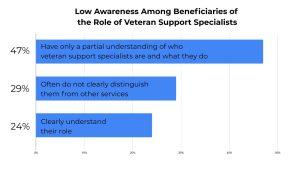
One of the key barriers remains low awareness among beneficiaries themselves. Only 24% of specialists believe that veterans clearly understand their role.
At the same time, 47% say that veterans have only a partial understanding, while 29% note that veterans often do not clearly differentiate veteran support specialists from other services. This complicates communication and may delay access to the assistance they need.
Unclear Boundaries of Responsibility
61% of specialists report they perform functions that formally belong to other services to some extent. For 26%, this is a regular practice, while another 26% say it happens occasionally.
This indicates unclear divisions of responsibility within the veteran support system. As a result, specialists are often required to take on additional tasks to address veterans’ needs, which increases their workload.
Barriers in Cooperation with Local Authorities
Specialists also report challenges in working with local self-government bodies. Among the main barriers, respondents identified:
- weak communication between services;
- unclear responsibilities;
- bureaucratic delays.
Conclusion
The survey results indicate that the institution of veteran support specialists is gradually being integrated into community-level veteran support systems. At the same time, this process continues to face a number of systemic challenges.
On the one hand, a significant share of specialists report positive changes in their professional work, including increased confidence in performing their responsibilities, the use of new case management tools, and improved communication with beneficiaries and other service providers. This suggests that the knowledge and tools gained through the project have practical value and are being applied in day-to-day work.
At the same time, the survey identified several challenges that affect both the effectiveness of specialists’ work and beneficiaries’ access to services. Some respondents noted that beneficiaries do not fully understand the role and responsibilities of veteran support specialists, which complicates communication and navigation within the support system.
An additional challenge is the growing workload placed on specialists. A significant number of respondents reported that they are required to perform functions that formally fall under the responsibility of other services or institutions. In such cases, specialists often take on additional tasks to ensure that veterans’ needs are addressed, which may lead to overload and an expansion of their responsibilities.
Also, specialists reported difficulties in cooperating with certain local institutions, particularly due to limited awareness of the role of veteran support specialists, communication barriers, and bureaucratic constraints. These factors may affect both the speed of resolving veterans’ requests and the overall effectiveness of specialists’ work.
Some respondents reported a lack of physical and psycho-emotional resources needed to perform their duties, which may create risks of professional burnout. This highlights the need for additional support mechanisms for specialists, including supervision, professional knowledge exchange, and access to practical tools.
Overall, the findings confirm that veteran support specialists play an important role in connecting beneficiaries with government institutions and services. At the same time, improving the effectiveness of this system requires greater awareness of their role, stronger coordination between services, and conditions that allow specialists to perform their duties without excessive workload.